
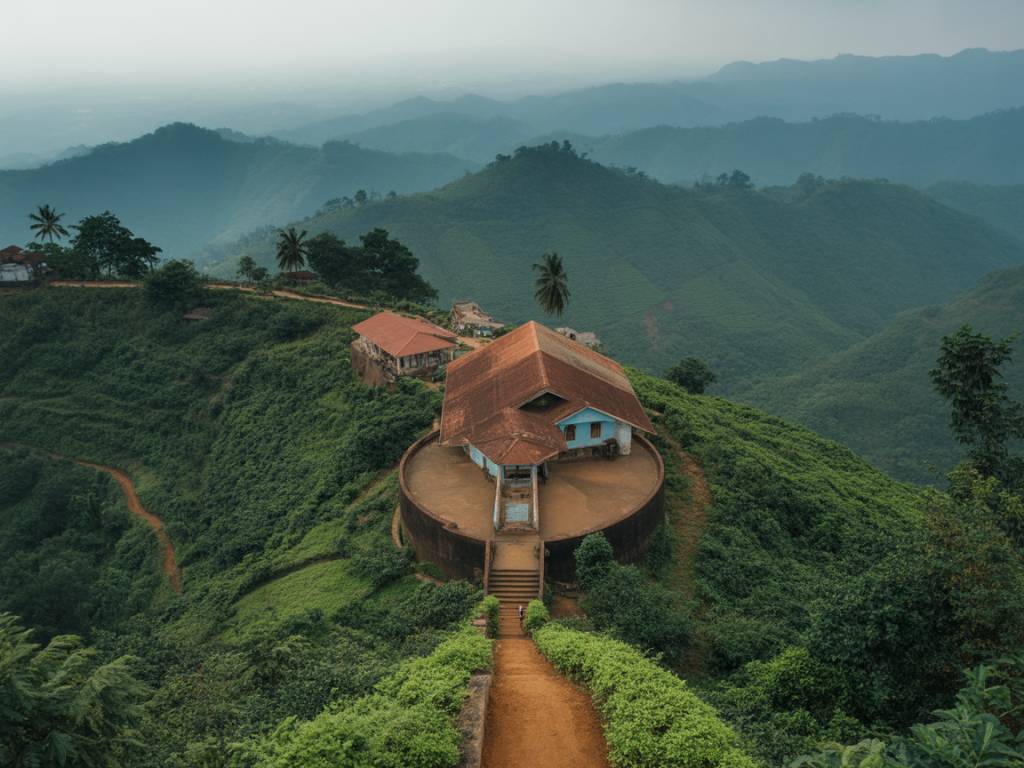
Coorg — or Kodagu, as it is officially known — sits quietly in the Western Ghats of Karnataka, wrapped in mist, coffee blossoms, and centuries of Kodava tradition. Often called the « Scotland of India », this hill district receives over 2,500 mm of rainfall annually, feeding dense forests, cascading waterfalls, and some of the finest coffee estates in Asia. Whether you’re a nature lover, a food explorer, or a culture seeker, the places to visit in Coorg India for nature, coffee and culture are remarkably varied — and consistently unforgettable.
Places to visit in Coorg India for nature, coffee and culture: the essential list
Coorg covers roughly 4,102 sq km, so knowing where to focus your time matters. The destinations below span the district’s most rewarding corners — from royal forts to Tibetan monasteries — and each one earns its place on an itinerary for a distinct reason.
Abbey Falls — where the forest crescendos
Around 10 km from Madikeri town, Abbey Falls is one of Coorg’s most photographed landmarks — and justifiably so. The trail to the viewpoint cuts through private coffee and spice estates, so the scent of cardamom and pepper greets you long before the roar of the water does. The falls drop roughly 70 feet into a rocky gorge, and are at their most dramatic between July and November, immediately after the monsoon.
- Best visited early morning to avoid crowds and catch soft light on the mist
- Entry is free; the surrounding estates are privately owned, so stay on marked paths
- Combine with a visit to the nearby Omkareshwara Temple, an unusual blend of Gothic and Islamic architecture built in 1820
Raja’s Seat — sunsets fit for kings
Literally translated as « Seat of the Kings », Raja’s Seat is a terraced garden in Madikeri town perched at roughly 1,525 metres above sea level. Kodava royalty once watched the sun set over the valley ridges from here — and the view remains as commanding as it must have been then. Mist rolls in from the valleys below at dusk, turning the landscape into something between a painting and a dream.
A small toy train operates inside the garden, making it a genuine family-friendly stop. Arrive 30 minutes before sunset and secure a bench at the garden’s western edge for the best panorama.
Madikeri Fort — history carved in moss-covered stone
Built originally in mud in the 17th century by Mudduraja of the Haleri dynasty, then reconstructed in stone by Tipu Sultan and later modified by the British, Madikeri Fort is a layered monument to Coorg’s turbulent past. Today it houses a small museum, a church that dates to 1855, and an active government office — a uniquely Indian mix of heritage and bureaucracy.
The ramparts offer fine views over Madikeri’s terracotta rooftops and forested ridgelines. Budget around 45 minutes here; the museum’s collection of Kodava weapons, royal artefacts, and colonial-era photographs rewards careful attention.
Coorg’s coffee plantations — the heart of India’s finest brew
Coorg produces approximately 30% of India’s total coffee output, making it the country’s single largest coffee-growing region. The district grows both arabica (at higher elevations above 1,000 m) and robusta (on lower slopes), typically under the shade of native timber trees — a method that supports biodiversity and produces a cleaner cup.
Walking the estates near Pollibetta and Virajpet
The southern taluks of Virajpet and Somwarpet harbour the densest concentration of working estates. Many welcome visitors for guided walks, especially between October and January when the red coffee cherries are ripe for harvest. Tata Coffee’s plantations around Pollibetta are among the most accessible, with structured tours that explain the full journey from cherry to export-grade green bean.
If you visit between late February and early March, you may catch the coffee blossom season — a brief, magical window when the entire landscape turns white with flowers that smell faintly of jasmine. Locals call it the « Coorg snowfall ».
Mercara Coffee Museum, Madikeri
For context before (or after) an estate walk, the Mercara Coffee Museum in Madikeri town traces the history of coffee cultivation in the region from the 17th century, when Baba Budan allegedly smuggled seven beans from Yemen. Exhibits include vintage processing equipment, varietal samples, and interactive brewing demonstrations. Entry is nominal and the on-site café serves single-estate filter coffee that is worth the trip alone.
Cultural places to visit in Coorg India — beyond the landscape
Coorg’s culture is as distinctive as its geography. The Kodava people have their own language (Kodava takk), their own martial traditions, and a cuisine that bears no resemblance to generic « South Indian » food. These sites bring that culture into sharp relief.
Bylakuppe — a Tibetan world within Karnataka
Roughly 35 km east of Madikeri near Kushalnagar, Bylakuppe is India’s second-largest Tibetan settlement, established in 1961 following the exile of Tibetan refugees. The Namdroling Monastery — popularly called the Golden Temple — is its spiritual centrepiece. Three gilded statues inside the main prayer hall (the largest standing over 18 metres) are among the largest such statues outside Tibet.
- The monastery complex includes multiple temples, a Tibetan school, and a small market selling thangka paintings and momos
- Visit during Losar (Tibetan New Year, usually February/March) for processions and butter lamp ceremonies
- Entry to the monastery is free; open daily from 9 am to 6 pm
Nalknad Palace and ancestral homes in Kakkabe
Kakkabe, a quiet village in the shadow of Thadiyandamol (Coorg’s highest peak at 1,748 m), is where traditional Kodava life feels most intact. The Nalknad Palace, built in the 18th century as a royal retreat, is a modest but evocative structure — its carved wooden interiors and enclosed courtyard convey the intimacy of Kodava domestic life far better than a formal monument would.
Around the village, Ainmane (ancestral homes) still house multi-generational Kodava families. Some open to guests for homestay experiences; these are among the most culturally immersive stays in the entire district.
Dubare Elephant Camp — conservation by the Cauvery
On the banks of the Cauvery River near Kushalnagar, Dubare Elephant Camp is run by the Karnataka Forest Department in partnership with Jungle Lodges & Resorts. Around 30 elephants — many formerly used in logging — are cared for here. Morning interaction sessions (between 8 and 10 am) allow visitors to assist mahouts in bathing and feeding the elephants.
This is not a performance venue; it is a working camp with a genuine conservation mandate. Access is by coracle (round reed boat) across the Cauvery, which adds a memorable touch to the visit.
The flavours of Coorg — a cuisine rooted in forest and ceremony
No account of places to visit in Coorg India for nature, coffee and culture is complete without its food. Kodava cuisine is built around pork, river fish, bamboo shoots, and wild mushrooms — ingredients foraged or farmed on these very hills for centuries.
- Pandi curry — slow-cooked pork in kachampuli (Coorg’s indigenous black vinegar), dark, sour, and deeply spiced
- Noolputtu — steamed rice noodles, eaten with coconut milk or curry
- Akki rotti — thick rice flatbread, the daily staple of Kodava households
- Kámpi curry — a soupy, spiced lentil dish served at ceremonial meals
Family-run restaurants in Madikeri, such as Rain Tree and Coorg Cuisine, prepare these dishes with home-recipe fidelity. For the most authentic experience, a homestay that includes meals is worth seeking out.
Practical tips for planning your Coorg visit
- Best time to visit: October to March for clear skies and cool temperatures (12–25°C). July to September for dramatic monsoon scenery and lush green estates — but expect road disruptions
- Getting there: Coorg has no airport. Mangalore Airport (135 km) and Bengaluru’s Kempegowda Airport (265 km) are the nearest. Private taxis offer scenic transfers; the drive from Bengaluru takes around 5–6 hours
- Getting around: A self-drive rental or hired cab is essential — public transport between sites is limited and slow
- Where to stay: Heritage coffee estate homestays such as School Estate and Silver Brook Estate near Madikeri offer immersive stays with planter-guided walks included
- What to pack: Light layers, waterproof jacket, sturdy walking shoes, and insect repellent for forest trails
Coorg doesn’t announce itself loudly. It rewards the traveller who slows down — who lingers over a second cup of estate-grown filter coffee, accepts a meal invitation from a Kodava family, or sits at Raja’s Seat long enough to watch the mist completely swallow the valley below. These places to visit in Coorg India for nature, coffee and culture are more than scenic stops; they are doorways into one of the Indian subcontinent’s most singular, quietly extraordinary ways of life.